

3D minimizers#
nvMolKit supports BFGS and the Fast Inertial Relaxation Engine (FIRE) for MMFF94 and UFF geometry optimization. BFGS is the default.
FIRE#
FIRE is an alternative to BFGS for workloads where iteration throughput is more important than minimizing the number of iterations.
The implementation follows the FIRE 2.0 update scheme. See the original FIRE paper, and the FIRE 2.0 paper
Using FIRE#
Select FIRE with minimizerKind="FIRE". BFGS remains the default.
The return value and in-place coordinate updates are the same for both
minimizers.
from rdkit import Chem
from rdkit.Chem.rdDistGeom import ETKDGv3

from nvmolkit.embedMolecules import EmbedMolecules
from nvmolkit.mmffOptimization import MMFFOptimizeMoleculesConfs
from nvmolkit.types import FireOptions

smiles = ["CCO", "c1ccccc1O", "CC(=O)NC1=CC=C(C=C1)O"]
mols = [Chem.AddHs(Chem.MolFromSmiles(smiles)) for smiles in smiles]

params = ETKDGv3()
EmbedMolecules(mols, params, confsPerMolecule=10)

options = FireOptions()
options.gradTol = 1e-4

energies = MMFFOptimizeMoleculesConfs(
    mols,
    maxIters=200,
    minimizerKind="FIRE",
    fireOptions=options,
)
# energies[i][j] is the final energy of conformer j of molecule i.
UFF uses the same FIRE options:
from nvmolkit.uffOptimization import UFFOptimizeMoleculesConfs

energies = UFFOptimizeMoleculesConfs(
    mols,
    maxIters=400,
    minimizerKind="FIRE",
    fireOptions=options,
)
The batched-forcefield interfaces also accept minimizerKind="FIRE" and
fireOptions=options in their minimize methods.
A conformer is converged when the 2-norm of its full gradient is no greater
than gradTol. Independent conformers are batched on the GPU; the adaptive
state and the convergence decision remain per conformer.
Performance#
At an equal iteration count, FIRE is roughly 2x faster than BFGS on all tested hardware.
Parameters and tuning#
The default values in nvmolkit.types.FireOptions were selected with
an Optuna study at a fixed budget of 200 iterations.
Defaults were tuned on MMFF94, but were independently verified to be valid for UFF optimization and distance-geometry embedding.
Validation#
We validated FIRE on 10,000 noise-perturbed MMFF94 conformers sampled from the Enamine REAL 10M collection. RDKit MMFF94, nvMolKit BFGS, and nvMolKit FIRE all started from the same coordinates and ran for 200 steps. Every final geometry was re-scored with RDKit MMFF94 so all energy comparisons use one implementation.
Comparing FIRE against BFGS from identical starting conformers, nearly all pairs sit on the parity line. Most of the conformers that fall off the diagonal are in FIRE’s favor: they lie below the parity line, meaning FIRE found the lower-energy minimum from that starting geometry.
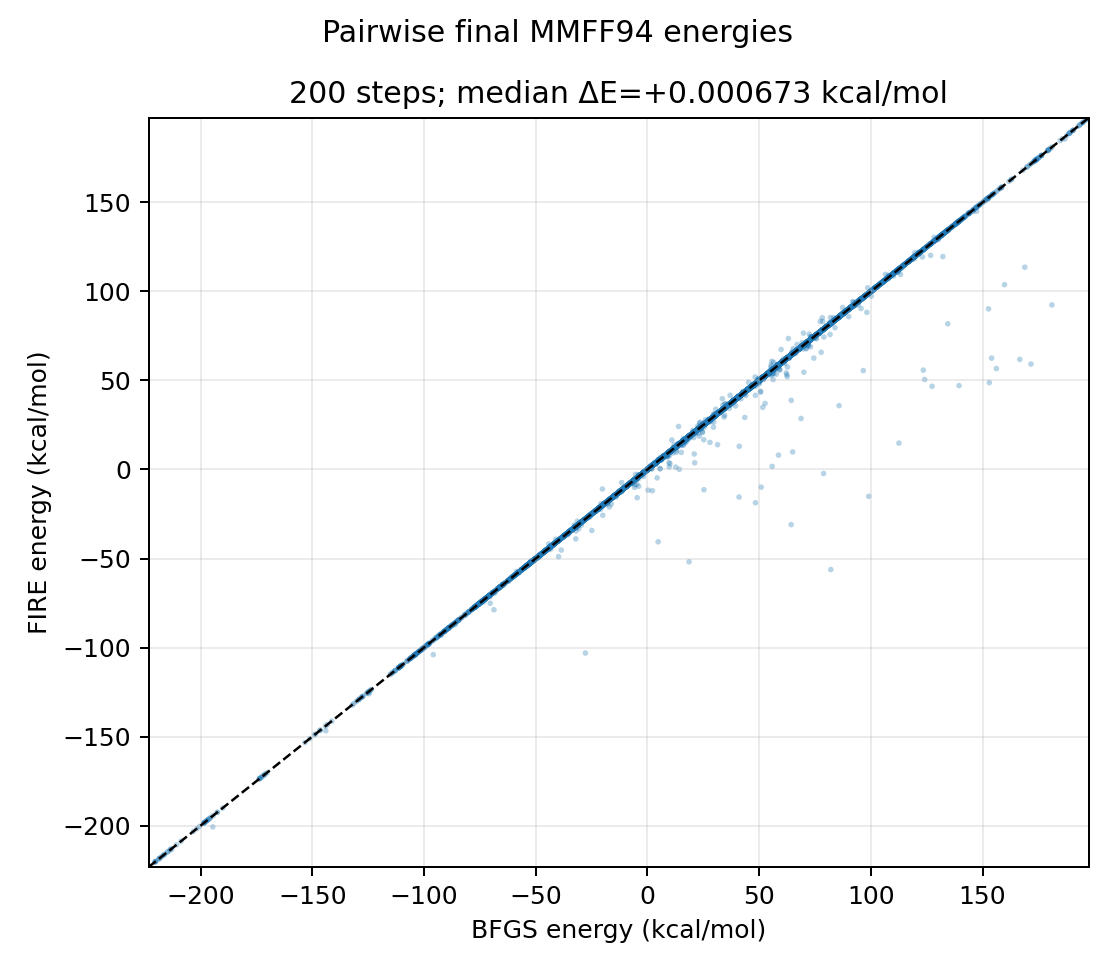
Pairwise BFGS/FIRE final energies from identical starting conformers. Points below the diagonal are conformers where FIRE reached the lower energy.#
Against RDKit as the reference, 93% of FIRE conformers finish within \(10^{-4}\) kcal/mol/atom of the RDKit energy, compared with 96% for BFGS. Within that bulk, FIRE sits slightly farther from RDKit: its median offset is \(+1.7\times10^{-5}\) kcal/mol/atom against \(+3.0\times10^{-6}\) for BFGS.
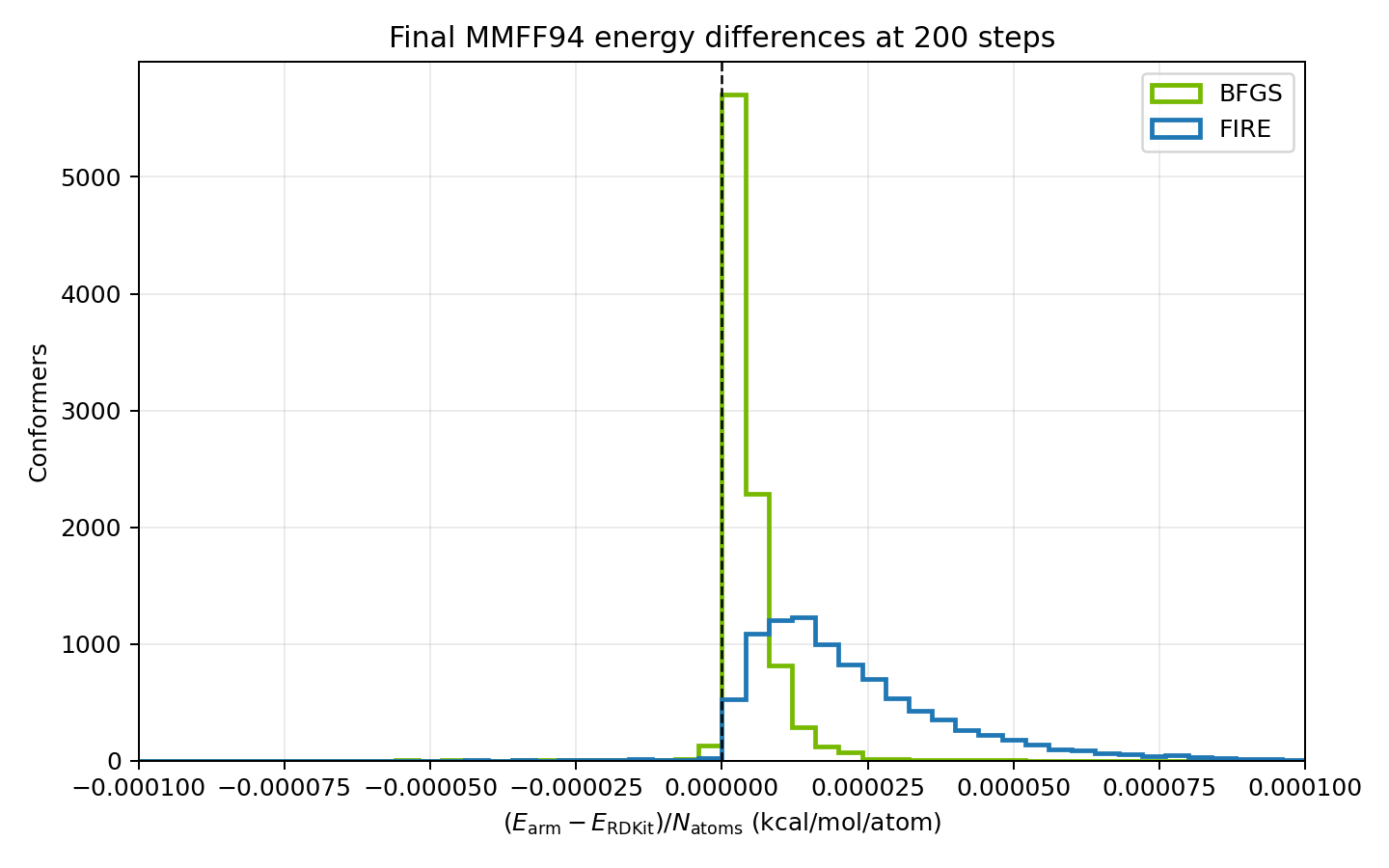
Final-energy difference distributions at 200 steps, shown over \(\pm 10^{-4}\) kcal/mol/atom.#
Taken together, at an equal iteration budget, FIRE’s bulk distribution is slightly looser than BFGS’s, while FIRE reaches the lower minimum on most of the conformers where the two minimizers end up in different basins.
Precision modes#
PrecisionMode.FULL uses double precision for coordinates, force-field
arithmetic, minimizer state, the BFGS inverse Hessian, and reductions.
Force-field parameters retain their defined storage types. PrecisionMode.SINGLE
uses single precision for all of those values. FULL is the default.
from nvmolkit.mmffOptimization import MMFFOptimizeMoleculesConfs
from nvmolkit.types import PrecisionMode

energies = MMFFOptimizeMoleculesConfs(
    mols,
    maxIters=200,
    precision=PrecisionMode.SINGLE,
)
The same precision argument is available for UFF, FIRE, embedding, and
batched force-field minimization. Public coordinates and energies retain their
float64 API representation. SINGLE supports the same minimizer backends as
FULL.
Validation#
We compared both precision modes against RDKit on a subset of the Enamine REAL
collection. For ETKDG conformer generation, SINGLE is equivalent to
FULL: the MMFF94 energies of the generated conformers agree with RDKit
equally well in both modes.
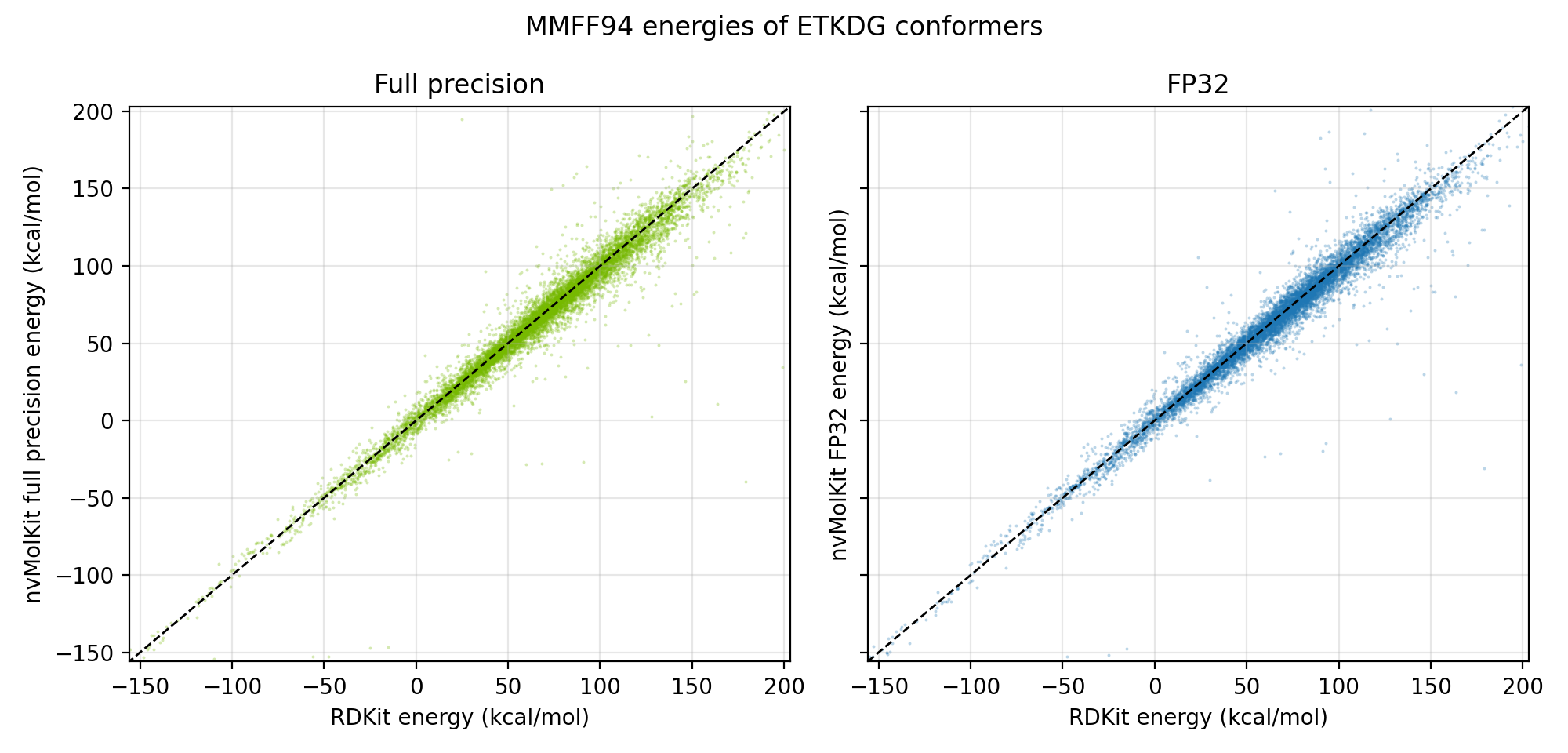
MMFF94 energies of ETKDG conformers, nvMolKit against RDKit.#
For MMFF94 minimization run for up to 500 BFGS steps, SINGLE converges to
the same minimum as RDKit for nearly all conformers, with a small number of
outliers reaching a different minimum. Final SINGLE energies sit slightly
above RDKit’s, with a drift on the order of \(10^{-5}\) kcal/mol/atom.
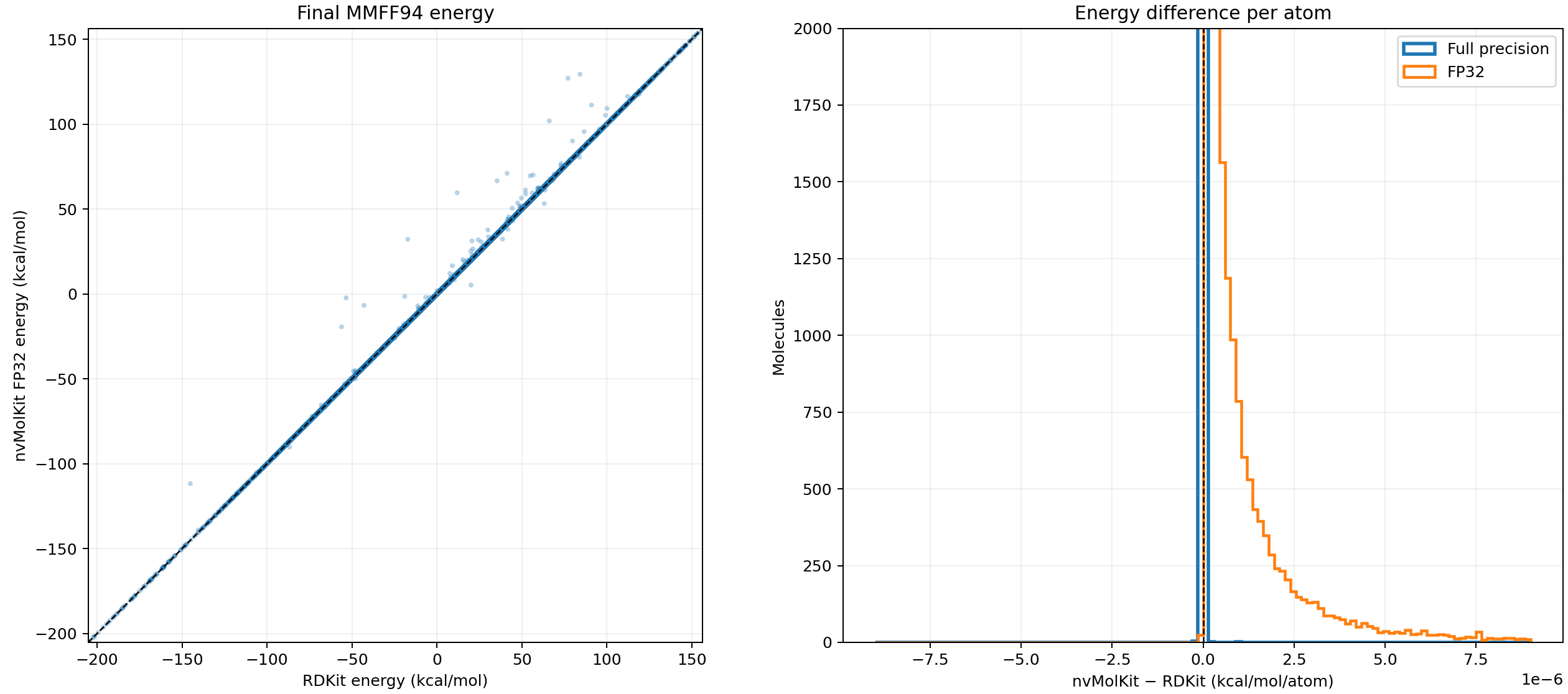
Final energies after MMFF94 minimization, nvMolKit against RDKit.#